44 food labels traffic light system
Traffic Lights | food labelling | nutrition - Foodcounts The total food energy value, expressed as "calories", is the primary visual indicator, using a traffic-light scale to indicate the three relative bands of low, medium [mid] and high. The coloured calorie traffic-light is underpinned by white traffic-lights to display the three main macronutrients of fats, proteins, carbs, on the same high-low ... (PDF) Traffic Light Food Labelling in Schools and Beyond Among the consumers who considered traffic light food labelling system at the point-of-purchase, most respondents had a clear idea about different colour codes and would like to consume food ...
Food labels - NHS Most pre-packed foods have a nutrition label on the back or side of the packaging. These labels include information on energy in kilojoules (kJ) and kilocalories (kcal), usually referred to as calories. They also include information on fat, saturates (saturated fat), carbohydrate, sugars, protein and salt.

Food labels traffic light system
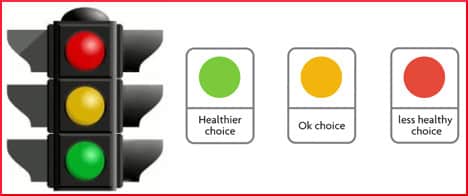
Food labelling - what you need to know | Health | Bupa UK The traffic light food labelling system helps you see whether a food or drink is healthy just by glancing at the colours on the label. The colours are: green = low amount in the food amber = medium amount in the food red = high amount in the food › signcast-virtual-signsSignCast Virtual (light) Floor Signs - Creative Safety Supply SignCast Jr. Replacement Bulb Replace burned out bulbs in your SignCast Jr. Virtual Floor Sign System with these 50W bulbs. These lamps use less energy than standard halogen lamps and they emit bright light without overheating... Food labelling: traffic light system vs activity equivalence Food labelling: traffic light system vs activity equivalence How Brexit will eventually affect the British economy, let alone the British packaging industry, is anyone's guess for now. Ask the Royal Society for Public Health (RSPH), though, and they'll tell you all about the activity equivalence labelling system they proposed in 2016.
Food labels traffic light system. Is the food traffic light labelling system useful? - Patient The traffic light label was introduced in 2014, as part of an initiative by the government to improve public health. It was designed to give consumers an immediate idea as to whether something is: healthy (green or low) or not (red or high) in terms of fat, sugar or salt. Traffic light system Check the label | Food Standards Agency The traffic light labelling system will tell you whether a food has high, medium or low amounts of fat, saturated fat, sugars and salt. It will also tell you the number of calories and kilojoules... Looking at labels - British Nutrition Foundation Front-of-pack labelling in the UK is voluntary but most of the major supermarkets and many food manufacturers provide this and use the government's recommended format - red, amber, green colour-coding and percentage reference intakes (RIs) - or as you may better recognise it - traffic light labelling. Western Australia Schools Adopt Traffic Light Food Labeling System In order to provide a simple visual guide to healthy eating, public school cafeterias use a traffic light system to label foods according to their nutritional value. "Green" foods and drinks include whole grains, fruits, vegetables, legumes, lean meats, and reduced-fat dairy products. Students are highly encouraged to eat these foods every ...
Traffic light labelling of meals to promote sustainable ... - ScienceDirect Traffic light labelling indicating carbon emission levels of food products has been used as a method of information provision to help increase consumer awareness around the subject, and to motivate behavioral change. Traffic Light Labeling System - Consumer Voice Traffic Light Labeling System In 2007, Food Standard Agency of UK developed a method of labeling food with a traffic light showing how much fat, sugar and salt are in that food. High Content (unhealthy) is shown by red, Medium (moderate) by amber and Low (healthy) by Green colors. Food with Green color is preferred over the ones with red color. Food labelling: traffic light system vs activity equivalence Food labelling: traffic light system vs activity equivalence How Brexit will eventually affect the British economy, let alone the British packaging industry, is anyone's guess for now. Ask the Royal Society for Public Health (RSPH), though, and they'll tell you all about the activity equivalence labelling system they proposed in 2016. › signcast-virtual-signsSignCast Virtual (light) Floor Signs - Creative Safety Supply SignCast Jr. Replacement Bulb Replace burned out bulbs in your SignCast Jr. Virtual Floor Sign System with these 50W bulbs. These lamps use less energy than standard halogen lamps and they emit bright light without overheating...
Food labelling - what you need to know | Health | Bupa UK The traffic light food labelling system helps you see whether a food or drink is healthy just by glancing at the colours on the label. The colours are: green = low amount in the food amber = medium amount in the food red = high amount in the food


New UK front of pack labelling standard – Nutritional Information Services

Traffic road infographic template vector 03 - Vector Business free download
Perspectives on the Traffic Light Label System | Childhood Obesity News

How to read a food label | Fusion OH

Stock Pictures: Traffic signals in Mumbai India

Now there are 'traffic light' labels for PET FOOD: New nutritional system lets owners know they ...
Post a Comment for "44 food labels traffic light system"